Growth-hormone signalling
CJC-1295 hormone timing at Pathway Peptide
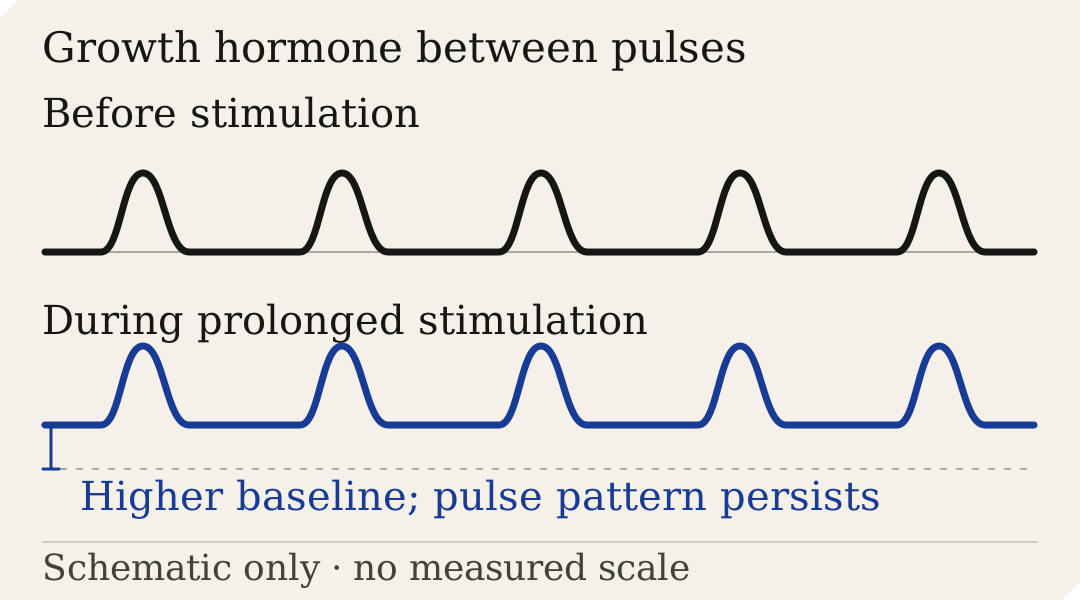
The revealing change occurred between the pulses. It explains how average hormone levels rose while the pattern of release persisted.
Basal growth hormone
The Ionescu and Frohman study of CJC-1295 contains a result I initially pictured incorrectly. Under continuous stimulation from a long-acting growth-hormone-releasing hormone analogue, the pituitary still released growth hormone in pulses. Their frequency and magnitude stayed similar. Basal levels, measured between pulses, rose and lifted the average.
After one week, IGF-1 was about 45% higher. I had imagined enlarged peaks; the reported pattern was subtler. This distinction matters whenever an average is doing all the work in a claim about hormone activity.
The drawing below separates the two features. It is a schematic of the finding, with no participant trace or measured concentration reproduced.
CJC-1295 DAC variants
CJC-1295 is a synthetic analogue of the active part of growth-hormone-releasing hormone. It prompts pituitary cells to release growth hormone, which then stimulates IGF-1 production. Changes to the peptide help protect it from rapid breakdown; the DAC form adds an attachment to albumin that extends its action. The review of GHRH and its analogues sets out this design problem.
The no-DAC form lacks that albumin-binding attachment and acts for a shorter time. Forum discussions often blur the names. I regard that confusion as a basic fault in any account that treats the two forms as interchangeable.
In early studies in healthy adults, mean growth hormone remained raised for at least six days, and IGF-1 for nine to eleven days. These are observations after study treatment, not a schedule for personal use.
The other proteins in the blood
The signal left more than a GH measurement behind. A study of 11 healthy young men examined changes in the serum protein profile. Some proteins rose as IGF-1 rose; others fell. The authors were exploring possible markers of growth-hormone-axis activation.
The less celebrated serum-protein work appeals to me: a body responding on several fronts to the same endocrine stimulus. Those protein changes also underline how narrow the evidence remains. The studies established hormone and protein responses in small groups over short periods. Muscle gain, fat loss, quicker recovery, longer life and better sleep remained unproved.
Sleep and safety
People describe deeper sleep, easier recovery after exercise, more energy and a leaner appearance. The same discussions include puffiness, water retention, tingling hands, local skin reactions, tiredness, headache, flushing and higher blood-sugar readings. These are anecdotal accounts rather than clinical evidence; mixed compounds and confused DAC names further complicate attribution.
Sustained growth-hormone and IGF-1 activity raises questions about fluid retention, insulin sensitivity and the growth of an existing tumour. These are mechanism-based concerns, with long-term CJC-1295 safety unresolved. A concern about growth signalling does not establish that this compound causes cancer.
CJC-1295 has no approval for use in people and is prohibited in competitive sport. An analytical report identified CJC-1295 in an unknown preparation, a reminder that a product name cannot settle its contents. For me, the trouble with the sleep and recovery claims is quite specific: the best human findings here concern hormone dynamics, while the advertised experiences still await their own convincing trials.